| With
decreasing temperature the membranes will stiffen. This will
not cause any significant problems with installation down to
the minimum temperature of 5~C. Pollyseal membranes remain
functional and flexible to well below -10~C and will remain
stable up to a normal maximum of 60vC.
Correctly
formed overlap joints will resist a head of water in excess
of 6m and will form a complete seal against the ingress
of water. The membranes are capable of tolerating normal
minor structural movements.
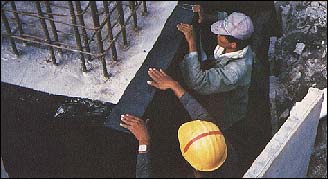
For most
Pollyseal waterproof membranes overlaps onto the backing
film are normally at least 50mm for the side laps and at
least 100mm for the end laps; certain products such as Pollyseal
S and Pollyseal GMA require greater laps. In case of doubt,
please consult Pollyaim Ltd
Where,
due to the construction program or in certain backfill operations,
there is the possibility of damage to the installed membrane,
then it should be protected by Pollyboard "O" Series
protection board. This may be fixed using Pollystik. or a
similar approved material.
Pollyseal 100,125
and 250 are for use as damp-proof and waterproof membranes
for solid concrete floors. underground structures, basements,
internal and external tanking applications, etc.
Pollyseal GMA
shows exceptionally high resistance to the transmission of
methane gas and very low permeability to radon gas.
Pollyseal range
of membranes has an effective adhesion on many known materials
including but not limited to concrete, wood, steel and most
plastics, etc.
Pollyseal
Selvedge
Pollyseal Selvedge is a bitumen rubber adhesive strip on one
side of the membrane, protected by a siliconised release strip.
When Pollyseal is overlapped onto the selvedge strip the adhesive
to adhesive contact provides a rapid seal contributing to the
continuity of the waterproofing system.
|